
diff options
| author | Christine Dodrill <me@christine.website> | 2021-07-14 21:26:10 -0400 |
|---|---|---|
| committer | GitHub <noreply@github.com> | 2021-07-14 21:26:10 -0400 |
| commit | aa6a92c06144b493641f059f562b4697eec2d7b4 (patch) | |
| tree | 2fa01d18f63f9fb47e990cedf81670f875027622 | |
| parent | b90b9a86dbab6c9db8432c070301fc12d3b0d266 (diff) | |
| download | xesite-aa6a92c06144b493641f059f562b4697eec2d7b4.tar.xz xesite-aa6a92c06144b493641f059f562b4697eec2d7b4.zip | |
emoji is not a language (#384)
* emoji is not a language
Signed-off-by: Christine Dodrill <me@christine.website>
* emoji is really not a language
Signed-off-by: Christine Dodrill <me@christine.website>
| -rw-r--r-- | blog/emoji-not-language-2021-07-14.markdown | 147 |
1 files changed, 147 insertions, 0 deletions
diff --git a/blog/emoji-not-language-2021-07-14.markdown b/blog/emoji-not-language-2021-07-14.markdown new file mode 100644 index 0000000..12e9c36 --- /dev/null +++ b/blog/emoji-not-language-2021-07-14.markdown @@ -0,0 +1,147 @@ +--- +title: Emoji is not a Language +date: 2021-07-14 +tags: + - linguistics + - philosophy +--- + +What is a language? This is something that is surprisingly controversial. +There's some easy ways to tell when something is a language (one of them being +that they have an army), but what about things like emoji? Is emoji a language? +In this article I will attempt to argue that emoji is not a language unto +itself. + +At a high level, language is a tool that we use to represent +spatial/temporal/conceptual relations between objects/ideas/things, statements +about reality and similar things among that nature. Many languages are broken +into units of meaning that we call words. Here are some example words: + +- the +- taco +- is +- beautiful + +We can break these words into two basic classes like this: + +| Content | Grammar | +| :------- | :------- | +| taco | the | +| beautiful | is | + +It's worth noting that not all verbs fall into the "grammar" category. Things +like "eat" would fall into a content word, however "is" is a special case +because it is directly drawing a relation between two things. In the sentence +"The taco is beautiful", there is a relation being made from one specific taco +and the abstract concept of beauty. + +I want to argue that emoji has plenty of content words, but no grammar words. If +we wanted to assemble an analog to "The taco is beautiful" in emoji, we could +make 1:1 correlations between English words and emoji like this: + +| English | Emoji | +|:------- |:----- | +| the | | +| taco | 🌮 | +| is | | +| beautiful | 🎀 | + +I dug through the entire emoji chart and was unable to find things that could be +used for "the" and "is". Heck, even the word I used for "beautiful" was a +stretch because the ribbon emoji is normally used that way. Is a language +defined by words that have inherent meaning or is that meaning arbitrarily +assigned by its users? Can I just firng out words like "xnoypt" as in "realizing +how the word would be pronounced, Tom [xnoypted](https://youtu.be/aMgCBYgVwsI) +out of existence"? Does that mean "xnoypt" is a word? + +The closest I was able to get to "the" and "is" would be metaphors that would +fall apart when you want to discuss the actual things involved. Let's say that +you assign arbitrary emoji at least to "is" so that you can end up with this +sentence in emoji: + +🌮➡️🎀 + +What if you want to talk about the concept of right though? Say you want to +convey that the taco store is to the right of the office building. You'd need to +say something like: + +🌮🏪➡️➡️🏢 + +And this could be easily confused with the interpretation "taco store right +right office building". + +But how do you know that it's a taco store? That's just a convention English +follows where the thing being described is the right-most thing and other things +on the left are just qualifiers or determiners to what's going on about it. It's +a "taco store", not a "store taco". Other languages like French do have this +reversed, so it could easily become a source of confusion. + +So what if you ripped out the grammar entirely? What if you just had something +that was pure content? Could utterances like "🌮🏪➡️🏢" function in place of +something that breaks apart the words into groups? How would people know the +difference between that being a giant list of descriptors on top of a taco or an +office building? + +How would you express verbs like "to eat"? Emojipedia says that 🍴 is used to +signify eating, but what about cultures that don't use cutlery to eat with? +Would this really be global enough to work in places like China? Cultural +cross-contamination would likely be enough at this point that most people could +get the message, but is this really representing the idea of eating or the idea +of something that you can use to eat other things? Would using this mean that +you could express what you ate with emoji? What would make it more of a concept +of eating than "to eat", "mangxi" (Esperanto), "manger" (French), or "citka" +(Lojban)? + +If language is a tool that we can use to describe relations, then we can sorta +get them across with emoji by piggy-backing on top of the grammar of other +languages. You can derive new words like "taco store" with phrases like "🌮🏪". +You can use these to create meaning, I guess, but it wouldn't be very precise. +You could get across the most common words and cultural ideas, but not much +else. + +Certainly not technical things where detail is important. Where is that taco +store in relation to the office building? Is it 5 meters to the right of it or +500 meters? What color is the office building? What name does it have? What is +the name of the road? What is the name of the taco store? + +What can you really convey with emoji that isn't also conveyed with words? + +You can create new words easily with some chat platforms and how they use emoji +though. You can either describe "nonbinary people" as "🚫🔢0️1️🧍" or you can just +upload an image of the [nonbinary pride +flag](https://gender.wikia.org/wiki/Pride_Flags#Nonbinary_Flag) to use as a +direct descriptor of the concept instead. In a way emoji gives you a level of +freedom of expression that simple words can't. The word "xnoypt" makes sense to +people that know the word, but the picture has a greater chance of being closer +to understood on its own. Here is an emoji that my coworkers use as a loving +description: + +<center> + +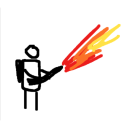 + +</center> + +This one is called `friday_deploy` and is used as the avatar of our deployment +bot as well as a way to describe the abstract horror of deploying software on a +Friday. By being an emoji it can represent something more than just the +pictograph that it is. + +These all certainly encode meaning on their own, but meaning on its own doesn't +make a language. Emoji certainly could become a language, but it would need a +lot of work to become one. Even then it would likely fall into the other +failings that International Auxiliary Languages that have fell into. It is +easier to type emoji than it is to type things like Esperanto's "ĉ", but it's +going to inherently encode assumptions in the creator's first language. + +Emoji is not a language, it's used to augment existing languages. + +> If you want to claim that emoji is a language, you should be able to make that +> same claim using emoji. Not an ad hoc cypher of the english sentence; just use +> emoji the way people commonly use them, which you're saying counts as a +> language, to say "Emoji is a language". + +- allthingslinguistic + +I'd be willing to be proven wrong if you can write "Emoji is a language" +unambiguously using emoji without it being a baroque cipher of English. |