
diff options
| author | Xe Iaso <me@xeiaso.net> | 2023-10-24 12:50:58 -0400 |
|---|---|---|
| committer | Xe Iaso <me@xeiaso.net> | 2023-10-24 12:50:58 -0400 |
| commit | 2b79b00b15a1b5f516ca10c6cf38c4da783de353 (patch) | |
| tree | 3bc0dc500d553f751a7912b55c40d45679565e67 | |
| parent | 064c2cf0a024fa67450f4511bd0d42adb4ec51cf (diff) | |
| download | xesite-2b79b00b15a1b5f516ca10c6cf38c4da783de353.tar.xz xesite-2b79b00b15a1b5f516ca10c6cf38c4da783de353.zip | |
move more assets to XeDN, reduce site zip further
This also compresses all compressible artifacts with gzip, enabling a
future XeDN patch to serve xeiaso.net directly.
This uses gzip in particular as an opportunistic speedhack for serving
gzip directly to clients that accept gzipped files.
Signed-off-by: Xe Iaso <me@xeiaso.net>


96 files changed, 290 insertions, 8025 deletions
diff --git a/internal/lume/zip.go b/internal/lume/zip.go index b3b331f..cecfb38 100644 --- a/internal/lume/zip.go +++ b/internal/lume/zip.go @@ -2,11 +2,32 @@ package lume import ( "archive/zip" + "compress/gzip" + "fmt" "io" + "log/slog" + "net/http" "os" "path/filepath" + "strings" ) +const compressionGZIP = 0x69 + +func init() { + zip.RegisterCompressor(compressionGZIP, func(w io.Writer) (io.WriteCloser, error) { + return gzip.NewWriterLevel(w, gzip.BestCompression) + }) + zip.RegisterDecompressor(compressionGZIP, func(r io.Reader) io.ReadCloser { + rdr, err := gzip.NewReader(r) + if err != nil { + slog.Error("can't read from gzip stream", "err", err) + panic(err) + } + return rdr + }) +} + // ZipFolder takes a source folder and a target zip file name // and compresses the folder contents into the zip file func ZipFolder(source, target string) error { @@ -33,21 +54,27 @@ func ZipFolder(source, target string) error { return nil } - // Open the file - file, err := os.Open(path) + // Create a header from the file info + header, err := zip.FileInfoHeader(info) if err != nil { return err } - defer file.Close() - // Create a header from the file info - header, err := zip.FileInfoHeader(info) + compressible, err := isCompressible(path) if err != nil { return err } - // Set the compression method to deflate - header.Method = zip.Deflate + if compressible { + header.Method = compressionGZIP + } + + // Open the file + file, err := os.Open(path) + if err != nil { + return err + } + defer file.Close() // Set the header name to the relative path of the file header.Name, err = filepath.Rel(source, path) @@ -66,3 +93,73 @@ func ZipFolder(source, target string) error { return err }) } + +// isCompressible checks if a file has a compressible mime type by its header and name. +// It returns true if the file is compressible, false otherwise. +func isCompressible(fname string) (bool, error) { + // Check if the file has a known non-compressible extension + // Source: [1] + nonCompressibleExt := []string{".7z", ".bz2", ".gif", ".gz", ".jpeg", ".jpg", ".mp3", ".mp4", ".png", ".rar", ".zip", ".pf_fragment", ".pf_index", ".pf_meta", ".ico"} + + // Get the file extension from the name + ext := filepath.Ext(fname) + + // Loop through the non-compressible extensions and compare with the file extension + for _, n := range nonCompressibleExt { + if ext == n { + // The file is not compressible by its name + return false, nil + } + } + + compressibleExt := []string{".js", ".json", ".txt", ".dot", ".css", ".pdf", ".svg"} + + // Loop through the compressible extensions and compare with the file extension + for _, n := range compressibleExt { + if ext == n { + // The file is compressible by its name + return true, nil + } + } + + // A list of common mime types that are not compressible + // Source: [1] + nonCompressible := map[string]bool{ + "application": true, + "image": true, + "audio": true, + "video": true, + } + + fin, err := os.Open(fname) + if err != nil { + return false, fmt.Errorf("can't read file %s: %w", fname, err) + } + defer fin.Close() + + // Read the first 512 bytes of the file + buffer := make([]byte, 512) + if _, err = fin.Read(buffer); err != nil { + return false, fmt.Errorf("can't read from file %s: %w", fname, err) + } + + // Detect the mime type from the buffer + mimeType := http.DetectContentType(buffer) + + // Split the mime type by "/" and get the first part + parts := strings.Split(mimeType, "/") + if len(parts) < 2 { + slog.Debug("can't detect mime type of file, it's probably not compressible", "fname", fname, "mimeType", mimeType) + return false, nil + } + mainType := parts[0] + + // Check if the main type is in the non-compressible map + if nonCompressible[mainType] { + // The file is not compressible by its header + return false, nil + } + + // The file is compressible by both its header and name + return true, nil +} diff --git a/lume/src/_components/ads.njk b/lume/src/_components/ads.njk index f11365d..c28070a 100644 --- a/lume/src/_components/ads.njk +++ b/lume/src/_components/ads.njk @@ -1,2 +1,2 @@ -<script async src="https://media.ethicalads.io/media/client/ethicalads.min.js"></script> -<div data-ea-publisher="christinewebsite" data-ea-type="text" data-ea-style="fixedfooter"></div>
\ No newline at end of file +<!--s<script async src="https://media.ethicalads.io/media/client/ethicalads.min.js"></script> +<div data-ea-publisher="christinewebsite" data-ea-type="text" data-ea-style="fixedfooter"></div>-->
\ No newline at end of file diff --git a/lume/src/blog/change-2021-10-20.mdx b/lume/src/blog/change-2021-10-20.mdx index 7639aa9..4125cb8 100644 --- a/lume/src/blog/change-2021-10-20.mdx +++ b/lume/src/blog/change-2021-10-20.mdx @@ -111,14 +111,14 @@ family of origin. <center> <picture> <source - srcset="/static/blog/change/the-dude-dither.avif" + srcset="https://cdn.xeiaso.net/file/christine-static/static/blog/change/the-dude-dither.avif" type="image/avif" /> <source - srcset="/static/blog/change/the-dude-dither.webp" + srcset="https://cdn.xeiaso.net/file/christine-static/static/blog/change/the-dude-dither.webp" type="image/webp" /> - <img src="/static/blog/change/the-dude-dither.png" alt="The dude abides" /> + <img src="https://cdn.xeiaso.net/file/christine-static/static/blog/change/the-dude-dither.png" alt="The dude abides" /> </picture> </center> diff --git a/lume/src/blog/gamebridge-2020-05-09.md b/lume/src/blog/gamebridge-2020-05-09.md index a6cab5b..b9fa782 100644 --- a/lume/src/blog/gamebridge-2020-05-09.md +++ b/lume/src/blog/gamebridge-2020-05-09.md @@ -24,10 +24,10 @@ two programs looks like this: [ufifo]: https://man7.org/linux/man-pages/man7/fifo.7.html  +gamebridge stack](https://cdn.xeiaso.net/file/christine-static/static/blog/gamebridge.png) You can view the [source code of this diagram in GraphViz dot format -here](/static/blog/gamebridge.dot). +here](https://cdn.xeiaso.net/file/christine-static/static/blog/gamebridge.dot). The main magic that keeps this glued together is the use of _blocking_ I/O. This means that the bridge input thread will be blocked _at the kernel level_ diff --git a/lume/src/blog/nixos-vr-hell-2021-12-02.mdx b/lume/src/blog/nixos-vr-hell-2021-12-02.mdx index f18d505..8f5469b 100644 --- a/lume/src/blog/nixos-vr-hell-2021-12-02.mdx +++ b/lume/src/blog/nixos-vr-hell-2021-12-02.mdx @@ -127,7 +127,7 @@ controllers in VR and it seemed like the occlusion model was backwards: <center>  +outside](https://cdn.xeiaso.net/file/christine-static/static/blog/vr-hellscape/backwards_controller.png) </center> @@ -326,7 +326,7 @@ like:  +logo.](https://cdn.xeiaso.net/file/christine-static/static/blog/vr-hellscape/steam_debian_arch_friendship.jpg) </center> @@ -343,7 +343,7 @@ off of it. My disk layout looks a bit like this: <center> - +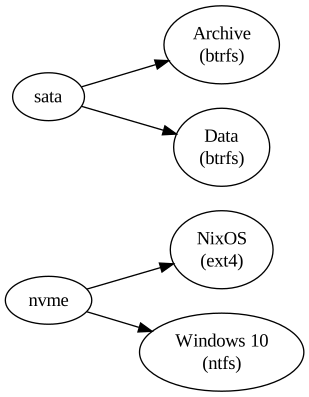 </center> @@ -444,7 +444,7 @@ wisdom: <center> - + </center> diff --git a/lume/src/blog/open-source-broken-2021-12-11.mdx b/lume/src/blog/open-source-broken-2021-12-11.mdx index bfe7ad0..ff0b5c7 100644 --- a/lume/src/blog/open-source-broken-2021-12-11.mdx +++ b/lume/src/blog/open-source-broken-2021-12-11.mdx @@ -58,7 +58,7 @@ are irrelevant.  +heartless taking without giving attitude](https://cdn.xeiaso.net/file/christine-static/static/blog/5xi3x7.jpg) </center> diff --git a/lume/src/blog/super-bootable-64-2020-05-06.md b/lume/src/blog/super-bootable-64-2020-05-06.md index 9da7171..e567eb1 100644 --- a/lume/src/blog/super-bootable-64-2020-05-06.md +++ b/lume/src/blog/super-bootable-64-2020-05-06.md @@ -37,7 +37,7 @@ crazy, wouldn't it?  +Hahaha porting machine go brrrrrrrr](https://cdn.xeiaso.net/file/christine-static/static/blog/portingmachinegobrrr.png) Someone did. The fruits of this effort are available [here][sm64dc]. This was mostly a proof of concept and is a masterpiece in its own right. However, @@ -369,7 +369,7 @@ cp /nix/store/fzk3psrd3m6x437m6xh9pc7bnv2v44ax-nixos.iso/iso/nixos.iso ~/Downloa Now you are free to do whatever you want with this, including [booting it in a virtual machine][bootinvmmp4]. -[bootinvmmp4]: /static/blog/boot2mario.mp4 +[bootinvmmp4]: https://cdn.xeiaso.net/file/christine-static/static/blog/boot2mario.mp4 This is why I use NixOS. It enables me to do absolutely crazy things like creating a bootable ISO of Super Mario 64 without having to understand how to diff --git a/lume/src/blog/templeos-1-installation-and-basic-use-2019-05-20.md b/lume/src/blog/templeos-1-installation-and-basic-use-2019-05-20.md index 492bf1c..bb9df47 100644 --- a/lume/src/blog/templeos-1-installation-and-basic-use-2019-05-20.md +++ b/lume/src/blog/templeos-1-installation-and-basic-use-2019-05-20.md @@ -40,31 +40,31 @@ TempleOS works decently with [VirtualBox](https://www.virtualbox.org) and [VMWar TempleOS is a 64 bit OS, so pick the type `Other` and the version `Other/Unknown (64-bit)`. Name your VM whatever you want: - + Then press Continue. [TempleOS requires 512 MB of ram to boot](https://github.com/Xe/TempleOS/blob/master/ReadMe.TXT#L11), so let's be safe and give it 2 gigs: - + Then press Continue. It will ask if you want to create a new hard disk. You do, so click Create: - + We want a VirtualBox virtual hard drive, so click Continue: - + Performance of the virtual hard disk is irrelevant for our usecases, so a dynamically expanding virtual hard disk is okay here. If you feel better choosing a fixed size allocation, that's okay too. Click Continue: - + The ISO this OS comes from is 20 MB. So the default hard disk size of 2 GB is way more than enough. Click Continue: - + Now the VM "hardware" is set up. @@ -72,29 +72,29 @@ Now the VM "hardware" is set up. TempleOS actually includes an installer on the live CD. Power up your hardware and stick the CD into it, then click Start: - + Within a few seconds, the VM compiles the compiler, kernel and userland and then dumps you to this screen, which should look conceptually familiar: - + We would like to install on the hard drive, so press `y`: - + We're using VirtualBox, so press `y` again (if you aren't, be prepared to enter the IRQ's of your hard drive/s and CD drive/s): - + Press any key and wait for the freeze to happen. The installer will take over from here, copying the source code of the OS, Compiler and userland as well as compiling a bootstrap kernel: - + After a few seconds, it will ask you if you want to reboot. You do, so press `y` one final time: - + Make sure to remove the TempleOS live CD from your hardware or it will be booted instead of the new OS. @@ -102,23 +102,23 @@ Make sure to remove the TempleOS live CD from your hardware or it will be booted The [TempleOS Bootloader](https://github.com/Xe/TempleOS/blob/1dd8859b7803355f41d75222d01ed42d5dda057f/Adam/Opt/Boot/BootMHDIns.HC#L69) presents a helpful menu to let you choose if you want to boot from a copy of the old boot record (preserved at install time), drive C or drive D. Press 1: - + The first boot requires the dictionary to be uncompressed as well as other housekeeping chores, so let it do its thing: - + Once it is done, you will see if the option to take the tour. I highly suggest going through this tour, but that is beyond the scope of this article, so we'll assume you pressed `n`: - + ### Using the Compiler - + The "shell" is itself an interface to the HolyC (similar to C) compiler. There is no difference between a "shell" REPL and a HolyC repl. This is stupidly powerful: - + ``` "Hello, world\n"; @@ -128,25 +128,25 @@ Let's make this into a "program" and disassemble it. This is way easier than it Open a new file with `Ed("HelloWorld.HC");` (the semicolon is important): - + - + Now press Alt-Shift-a to kill autocomplete: - + Click the `X` in the upper right-hand corner to close the other shell window: - + Finally press drag the right side of the window to maximize the editor pane: - + Let's put the hello word example into the program and press `F5` to run it: - + Neat! Close that shell window that just popped up. Let's put this hello world code into a function: @@ -160,7 +160,7 @@ HelloWorld; Now press `F5` again: - + Let's disassemble it: |