
diff options
| author | Xe <me@christine.website> | 2022-09-10 17:20:28 +0000 |
|---|---|---|
| committer | Xe <me@christine.website> | 2022-09-10 17:20:28 +0000 |
| commit | ba28966de6d7de4b36cd3278e00a01432680b944 (patch) | |
| tree | e65e8e55993416e0b02f86ee3db27c4ccc72b647 | |
| parent | 3d701c8fccb20ae86910420024c0e3ffa060c7d8 (diff) | |
| download | xesite-ba28966de6d7de4b36cd3278e00a01432680b944.tar.xz xesite-ba28966de6d7de4b36cd3278e00a01432680b944.zip | |
weird smartcard
Signed-off-by: Xe <me@christine.website>
| -rw-r--r-- | blog/trying-to-use-security-token.markdown | 385 |
1 files changed, 385 insertions, 0 deletions
diff --git a/blog/trying-to-use-security-token.markdown b/blog/trying-to-use-security-token.markdown new file mode 100644 index 0000000..8b4e29c --- /dev/null +++ b/blog/trying-to-use-security-token.markdown @@ -0,0 +1,385 @@ +--- +title: My new, weird smartcard and how I learned to use it +date: 2022-09-17 +tags: + - gpg + - fido2 + - webauthn + - 2fa + - smartcard +--- + +<xeblog-hero ai="Stable Diffusion" file="golden-hill" prompt="a golden hill in front of a sunset, forgiveness, color tinted skies, matte painting"></xeblog-hero> + +<div class="warning"><xeblog-conv name="Cadey" mood="coffee">Hey, this article +is going to talk about something related to a subject that is fairly divisive +and I want you to seriously re-evaluate your reactions before you act on your +first impulse. I've been working towards my goal of being <a +href="https://xeiaso.net/blog/against-toxicity-programming-languages">a better, +less toxic person</a> and something that has come up repeatedly in that +self-re-evaluation is that I have been horribly toxic against people that like +cryptocurrencies.<br /><br />I have been needlessly horrible to people. I have +sowed toxicity. I have furthered divides that do not need to exist. A lot of +this has been out of the fear of inadvertently scamming people or leaving people +open to be scammed, but after deep introspection, I no longer want to be known +for that. It feels so <i>right</i> in the moment, I feel that fear and I have +lashed out in anger because of it.<br /><br />No more. I do not want to be known +for fostering hate, resentment, or anything adjacent to it. If you were one of +the people I have hurt with my toxicity, I whole-heartedly apologize and I am +going to reach out to the people I feel I have hurt the most to apologize +privately.<br /><br />As you read this article, please try to take things at +face value and reconsider your gut feelings as I have been. Hate is learned. +Let's work to unlearn it. Fear can't lead to anger, hate, or suffering if we +choose to not let it.</xeblog-conv></div> + +> The best things in life come with disclaimers +- Socrates, probably + +When you speak for professional conferences, sometimes you get a goodie bag with +random stuff in it. Recently [I spoke at +RustConf](https://xeiaso.net/talks/rustconf-2022-sheer-terror-pam) about +authentication technologies. Among other things (such as a very nice picnic bag +that I will be sure to make use of), I got a [Ledger Nano +X](https://shop.ledger.com/products/ledger-nano-x) hardware cryptocurrency +wallet. It is a custom engraved one too. It looks really, really nice. Here's a +picture of it: + +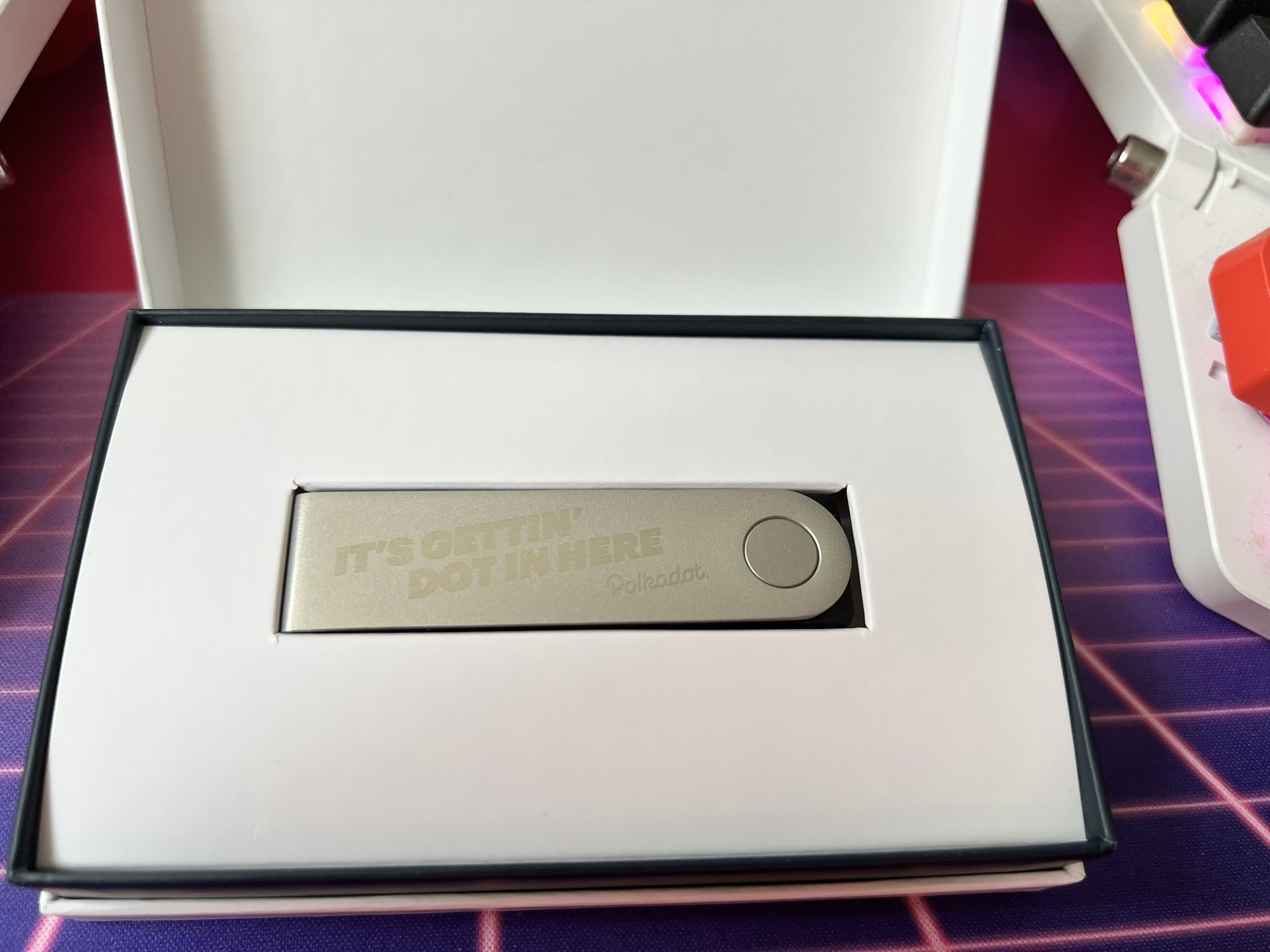 + +I am not really a Bitcoin person. Most of my experiences in the cryptocurrency +space have been overwhelmingly negative. I'm pretty sure a huge part of the +reason I was made to drop out of school has to do with the fact that a large +part of my college tuition was being paid for with Bitcoin...through [Mt. +Gox](https://en.wikipedia.org/wiki/Mt._Gox). + +<div class="warning"><xeblog-conv name="Cadey" mood="coffee">It's worth noting +that this is not a paid review. I was not asked to write this article. I +consciously chose to write this article based on my experiences (mostly after +the debacle with trying to use it as a GPG smartcard, see below). I am not +involved with Polkadot, The Web3 Foundation or anything involved with that +technology. I was given the device as part of a wide gift program with no +expectations or targeting. I have no affiliation with Polkadot or the Web3 +Foundation.</xeblog-conv></div> + +You can see how that would sour my views on cryptocurrency, eh? + +One of the most positive experiences I had with cryptocurrency was when someone +donated about $200 in ethereum to me. Coinbase let me turn that into money +dollars fairly easily. Probably could have made more if I held onto it, but +overall, it was a good experience. + +## Setting it up + +So now here I am with this hardware key escrow device and now I need to figure +out how to use it. I read that these things can also be used as very paranoid +GPG smartcards, WebAuthn tokens, and even _password managers_. This is very +interesting to me, even if I'm not totally jazzed about the other associated +uses of such a key escrow hardware token. + +<xeblog-conv name="Cadey" mood="coffee">Fun fact, I looked to see what the +resale value of these devices are in the secondhand market. Turns out the target +market for these things actively avoids secondhand devices. Can't blame them. +This is a very paranoid device designed to cater to a very paranoid market. +Buying such a hardware token second-hand is very counter to that view of +paranoia. Arguably by finding _any_ use for it I am preventing E-waste, but more +on that later as the saga continues...</xeblog-conv> + +Either way, this thing is in front of me, so I want to see what I can actually +do with it. So, I started out by unpacking it and going through the +first-time-user-experience (FTUX). + +Devices like this have a deterministic random-number-generator that is seeded by +an initial entropy seed. When the device generates this entropy seed, it also +creates a recovery phrase for it. The recovery phrase is a 24 word series of +random English words that [correlate to hexadecimal +values](https://github.com/Bitcoin/bips/blob/master/bip-0039.mediawiki). This +allows you to be able to load that seed into a new device should your old one +break. Because all of the randomness is deterministically generated from the +original seed, this means that you can recreate all the private keys for all of +your cryptocurrency accounts without the private keys ever having to leave the +old device. Even if you totally obliterate the original device. This is pretty +neat. + +Another neat part about the FTUX is that when it presents the recovery phrase, +it asks you to write it down (and even includes a little card for you to do so). +Once it's shown you the whole phrase and you've written it down, then it does +something that both surprised me and has really made me rethink cryptographic +key generation in general: it makes you confirm what every part of the key +phrase are. It also puts incorrect answers in the options. This is _genius_. It +both proves that you have written the passphrase down _and that you did it +correctly_. If I ever make something that has cryptographic keypairs like this, +I'm going to be sure to remember this and add it to the FTUX whenever I can. + +So, at this point I have a hardware cryptocurrency wallet set up and after +following the instructions for setting up the app, I got a prompt to update the +firmware. I did. I got another prompt to update the firmware. I did. + +<xeblog-conv name="Mara" mood="hmm">Weird that it didn't just slipstream the two +updates into one big one. I would have expected it to do that.</xeblog-conv> + +After that was all done, I enabled "Developer mode" in their app and downloaded +the following apps: + +- [FIDO 2/U2F/WebAuthn key support](https://support.ledger.com/hc/en-us/articles/115005198545-FIDO-U2F?docs=true) +- [Passwords](https://support.ledger.com/hc/en-us/articles/360017501380-Passwords?docs=true) +- [GNU Privacy Guard (gpg)](https://support.ledger.com/hc/en-us/articles/115005200649-OpenPGP) +- Ethereum (to only be used after The Merge to a proof of stake chain, still not + sure how things are going to work out there but at the very least I want to + maintain it as _an option_, if only for my private experimentation) + +At this point I realized that the CAD$200 device in front of me only had _two +megabytes_ of usable storage. This feels like a very small amount to me, but +when I looked at the filesizes of the apps it turns out it's okay. At this time +with those apps, I'm only using 1/4th of the total storage of the device. + +<xeblog-conv name="Mara" mood="hmm">I wonder if they're using a smaller amount +of storage because it's more durable. I also wonder if the lion's share of the +cost comes from the hardware security element bits and the amount of validation +and formal verification that goes into developing something like this. Either +way, for the very small keypairs (Ethereum keypairs are 256 bits) that are being +stored it's probably fine this way. Still kind of weird, but it's +tolerable.</xeblog-conv> + +<xeblog-conv name="Numa" mood="delet">They could probably cheat even and take +advantage of the deterministic nature of the randomness to avoid storing the +keypairs in the first place. If there's a deterministic random seed then you +theoretically don't even need to store the keypair in the first place, just keep +track of which "account" correlates to which entropy step from the initial seed. +It'd be a bit jank but it should work perfectly.</xeblog-conv> + +## Testnet testing + +Now that I had everything set up, I decided to test it with a testnet +transaction with the infamous Bitcoin testnet. In the past, the Bitcoin testnet +has been something that I've used to validate that a cryptocurrency client is +working. The Bitcoin testnet is effectively a second copy of Bitcoin that has a +lot less traffic and it's mutually agreed that testnet coins have zero monetary +value. + +<xeblog-conv name="Numa" mood="delet">Turns out money only has value if everyone +agrees that it does.</xeblog-conv> + +I downloaded the app, generated an account on the testnet, then pasted the +address into some random [Bitcoin testnet +faucet](https://testnet.help/en/btcfaucet/testnet). Bitcoin "faucets" were +public services that gave people a small amount of Bitcoin to test that they can +make transactions. As Bitcoin grew in value, the level of abuse towards faucets +increased drastically to the point that they stopped existing. The only +remaining ones are for the Bitcoin testnet, which have no real monetary value. + +I saw my account balance go up. Success! I had managed to use this hardware +device for the purpose it was designed for. I was now a lot more confident in +going off script and really having fun with the thing. After returning the +testnet funds back to the faucet (this is considered a polite move), I deleted +the Bitcoin testnet application from the device and started planning my next +move. + +<xeblog-conv name="Mara" mood="hmm">If you delete the app, do the keypairs +disappear too?</xeblog-conv> + +<xeblog-conv name="Cadey" mood="enby">No. Remember that the keys are +deterministically generated from a seed value. This means you can reinstall the +app later and get your accounts back. This also extends to the other +applications on this device. This is one of the most genius ways to use +deterministic randomness I have ever seen and is certainly why there is so much +dire messaging around keeping your recovery phrase secure. I'm considering +putting a copy of my recovery phrase in a safety deposit box or +something.</xeblog-conv> + +## FIDO2/U2F/WebAuthn + +Hardware token based authentication has gotten complicated as standards have +been developed. However, most of the tokens have standardized around the +[WebAuthn](https://en.wikipedia.org/wiki/WebAuthn) protocol, which uses a +secure element to sign messages from a server and then the server checks the +signatures to ensure the same device sent the message. This means that you can +have a hardware token like a [Yubikey](https://www.yubico.com/) to securely +authenticate to remote services like Google, GitHub, and DashLane. + +However, Yubikeys aren't your only option. The secure element in M1 macs can be +used for WebAuthn. The TPM in your Windows 11 PC can be used for WebAuthn (I'm +pretty sure this is why Windows 11 requires a TPM). And, the [Ledger Nano X +supports WebAuthn (via +FIDO2)](https://support.ledger.com/hc/en-us/articles/115005198545-FIDO-U2F). + +You can set it up by following their documentation, but at a high level you do +this: + +- Install the FIDO U2F application to your wallet +- Open the app on the wallet +- Open the security key registration page for your service of choice (On GitHub + it's [here](https://github.com/settings/two_factor_authentication/configure)) +- Hit "Register new security key" (or whatever the site says) +- Confirm on your device + +Et voila! You have set up this hardware key escrow device as a security device. +It should Just Work. You can test it by logging out of GitHub and then trying to +log back in with the wallet unlocked. You will be prompted on the wallet to +accept the request. You can say "yes" or "no" and things will work out. + +I did have some problems getting it to work with Safari though. With Safari on +my MacBook Air I'm not able to reliably use this device as a hardware security +key. For some reason Safari keeps spamming signature requests to the device and +accepting the signin is probably frame-perfect. I haven't been able to get it +working, but it does work with Microsoft Edge. So there is that. + +At first when I tried to use it on Windows 11, Windows got very confused. It +kept trying to use my tower's TPM as a WebAuthn key. However things worked fine +when I tried using it on my MacBook. It worked perfectly on Linux, to nobody's +surprise. + +I would be willing to say that this hardware cryptocurrency wallet is a decent +FIDO2 key. It's also the only FIDO2 key I know of that makes you unlock the +device with a PIN (one that you enter on the device itself) before you can use +it. I don't think it's worth going out and buying one just for that though, it +doesn't have support for [`ed25519-sk` SSH keys in resident +mode](https://xeiaso.net/blog/yubikey-ssh-key-storage), which means that your +SSH key can't be stored on the device itself unless you use GPG, which is kinda +lame but understandable given the constraints of this device. + +<xeblog-conv name="Mara" mood="hacker">It will work for non-resident keys +though! It is a lot cooler to put the keys directly on the device, but in a +pinch it's okay.</xeblog-conv> + +## Password management + +This device is basically a hardware random number generator with a bunch of +fluff about cryptocurrency on top. Secure passwords are basically just a bunch +of random data encoded as printable characters. It's reasonable to go from +"random data" to "password" with some trivial transformations. + +This device has a password manager built in. You can install it by following the +[directions from +upstream](https://support.ledger.com/hc/en-us/articles/360017501380-Passwords?docs=true). + +It will let you generate passwords from that base passphrase and then it can +pretend to be a keyboard to type them out very quickly. I'm going to keep this +around, but I don't personally see myself using this device as a password +manager. I already have password managers do what I need. + +However in a pinch, I could see this being a viable option. If I was a lot +bigger into the cryptocurrency ecosystem and I was very paranoid about password +theft, I'd probably want to use something like this as a password manager. If +only because the PIN-lock would make me feel better about it. + +<xeblog-conv name="Cadey" mood="coffee">The placebo effect is real.</xeblog-conv> + +## GPG + +Okay, I've been putting this off for long enough. Let's go over the final boss +of security hardware: pretending to be a GPG smartcard. + +[GNU Privacy Guard (GPG)](https://gnupg.org/) is one of the oldest, most mature, +and widely known privacy ecosystems in the world. The basic idea is that it +gives you a keypair that you can use to do the following things: + +- Sign messages to let people prove you published it +- Encrypt messages to target specific people so that nobody in the middle can + understand the message +- Authenticating yourself to SSH servers or other systems + +One of the main downsides is that the user experience is awful. It is so bad. I +have [tried to use GPG in the past and +failed](https://xeiaso.net/blog/new-gpg-key-2021-01-15) numerous times. +Including but not limited to accidentally creating a key that can't be used for +anything. + +I knew I was in for a ride, but I didn't quite think it would be as bad as it +was with this device. So I opened [their +documentation](https://github.com/LedgerHQ/openpgp-card-app/blob/942e16f74ab8aa71644be8e6780ef63109cba599/doc/user/blue-app-openpgp-card.pdf) +and looked at how to do it on my mac. It looked normal at first, then I got to +this part that I am going to quote verbatim: + +> - First it is necessary to [disable SIP (System Integrity Protection, it +> basically turns MacOS into an immutable OS for security reasons)](https://developer.apple.com/library/mac/documentation/Security/Conceptual/System_Integrity_Protection_Guide/ConfiguringSystemIntegrityProtection/ConfiguringSystemIntegrityProtection.html) That doesn’t allow the editing of files in /usr/. +> - You have to add the Nano S to [the end of each list in the file] `/usr/libexec/SmartCardServices/drivers/ifd-ccid.bundle/Contents/Info.plist`: +> - In <key>ifdVendorID</key> add the entry <string>0x2C97</string> +> - In <key>ifdProductID</key> add the entry <string>0x0001</string> +> - In <key>ifdFriendlyName</key> add the entry <string>Ledger Token</string> +> - [Enable SIP](https://developer.apple.com/library/content/documentation/Security/Conceptual/System_Integrity_Protection_Guide/ConfiguringSystemIntegrityProtection/ConfiguringSystemIntegrityProtection.html) + +<xeblog-conv name="Mara" mood="sh0rck">W...what. In order to use a _security +device_ they want you to _disable the trust layer of macOS_ to append some XML +to a random file? How on earth is that safe? What were they +_thinking_???</xeblog-conv> + +<xeblog-conv name="Cadey" mood="coffee">Yeah, I've been trying to keep a +positive tone for this article and assume good intentions, etc. But oh god this +is like a red flag the size of Australia. What the hell where they thinking? +This is kind of hot take worthy even though that goes against the anti-toxicity +point I raised in the header of this article. I really don't know what to say +here. I am kind of speechless.</xeblog-conv> + +This understandably discouraged me from trying to use the device as a hardware +PGP key (though if it worked as one it would be quite possibly one of the best +conference swag gifts ever, if only because something that I only use as a GPG +key would be so invaluable, you have no idea). + +Last night, on a lark I decided to try using it anyways. It worked on my MacBook +Air without having to crack open the readonly seal. I was shocked at first, then +very annoyed that the docs both told you to do something extremely very wrong +and they were outdated. + +Whatever. It works as a GPG smartcard. That makes it worth using for me in +particular. I don't really use GPG much, but when I do it's going to be nice to +have my keypair already set up and ready. + +## The battery saga + +When I unplug the device, the screen turns off. I thought this was normal. Turns +out it isn't. It has a 100 milliamp-hour battery in it. The battery isn't +working on my device. I have tried charging it with the following devices, just +in case: + +- Steam Deck charger +- Anbernic Win600 charger +- Nintendo Switch charger +- My tower PC +- My MacBook +- An old 5 watt iPhone charger I had to dig up out of storage + +I can't get the device to charge. It only works over USB. This is okay-ish for a +smartcard, but it would be nice if the device worked up to the manufacturer's +specifications. You know, just in case I actually use it as a password manager +for some reason. + +I contacted the manufacturer, who was very confused and said that I didn't have +an order registered in their system. Understandable. I didn't have an order, +this was a free gift from a conference sponsor. + +I got in contact with the sponsor and apparently they're just gonna send me a +whole other hardware wallet so I guess I'm going to have two of them. Hopefully +one of them will have a working battery. + +<xeblog-conv name="Numa" mood="delet">Yummmmm, sweet e-waste!</xeblog-conv> + +## Conclusion + +This device is an okay hardware token. It is a very paranoid security device and +if you are actually into cryptocurrency, it's probably a decent option. I'm not +into cryptocurrency though, so I am a bad person to take this kind of advice +from. + +A friend of mine that is very into cryptocurrency has told me that Ledger is the +"bad option" for hardware wallets and that most of the mindshare is with +[Trezor](https://trezor.io/) devices. These devices also apparently have the +best UX. I don't know for sure. I only have a Ledger Nano X in front of me, and +if this is the _bad_ option, then better options are surely much easier to use. + +I just wish this wasn't tied to cryptocurrency, but I can deal with it. Can't +beat the price! + +--- + +As an aside, during the process of trying to figure things out, I tried to read +into how some of the currencies that the Ledger app supports work. The level of +jargon is impressive and impenetrable to someone like me without very much +context as to what is going on. This is how people outside of tech see our +profession. This really gives me pause and has made me wonder how we can make +things in tech more equitable so that other people can come up to speed more +easily. + +Maybe things should be written in a way that is easier to understand and +gradually introduces jargon as the user gets more familiar. |